

Guitar For Busy People, Lesson 9 - Mistakes To Avoid And Your First Daily Exercises
How to avoid mistakes that slow your progress down


The Lessons So Far
Introduction
In this lesson, I’m going to show you some mistakes that you should absolutely avoid when playing guitar, from how you hold the instrument to how you hold the pick.
And while some of them will be focused on building speed, how you should hold the guitar is the same, regardless of what type of guitar you have.
So, let’s begin.
Holding The Guitar And Strumming
Alright, so for the first section of this post, I would highly recommend you watch this video:
Now, let’s discuss it for a bit. What I want you to remember from this one is how to correctly hold the guitar. I’ve only just recently started holding it like this person says, as I was, of course, guilty of holding it like he says we shouldn’t.
And if you don’t have any like foot support, just put any sort of box or pillow that lifts your foot there, if you truly need it.
As for the guitar pick, the lesson is focused more on mistakes people make when they want to build speed. So not all of it might apply to what you want to do, just FYI.
When it comes to the guitar pick, if you want to play songs like…I dunno, at a campfire, you probably don’t need a very thick one, else your chords will sound choppy.
As for actually playing chords, Brian Haner Sr. (who you may know as Papa Gates, father of Avenged Sevenfold guitarist Syn Gates) has a lesson on this on his son’s guitar school website (or had, that site kinda went…bad).
Basically, you want to keep an up-down motion with your playing hand all the time, even when you’re not supposed to play anything. In order to better illustrate this, let’s take a look at two different rhythms that you can play:
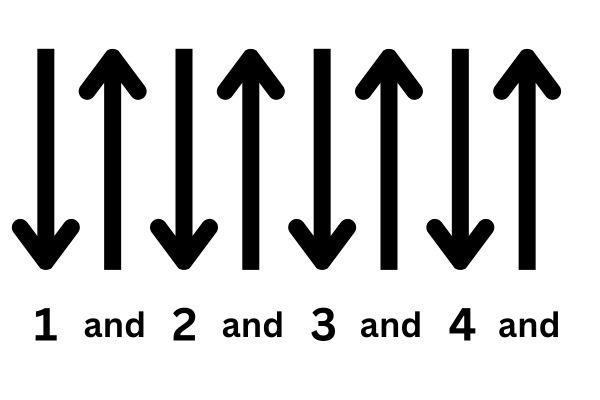
For this one, you basically have 8 eighth notes. You start by playing a downstroke (towards the ground) on the first beat, and an upstroke on the half-beat. As you can see, for such a rhythm, your hand is constantly moving up and down and playing a note/chord every time.
Let’s take a look at another example:
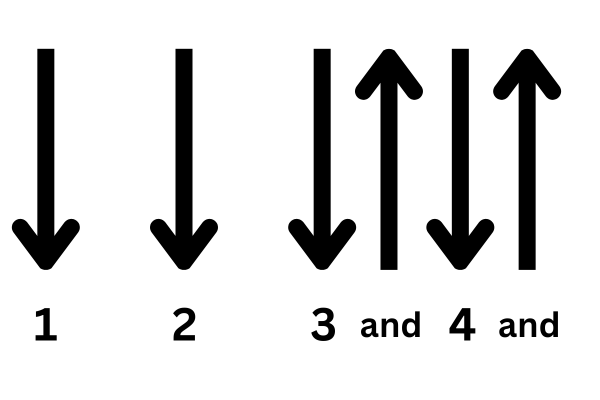
As you can see here, the first two notes are quarter notes, and you play them using downstrokes. However, the idea is to keep the up-down movement going even between the quarter notes, even though you’re not meant to play any note.
The final note on this is to make sure you’re not swatting flies when doing your playing. While Pete Townshend’s style is spectacular, it’s also a recipe for getting tired quickly when playing for long periods of time. And if you have no idea what I’m talking about, check out this video:
Basically, when you play, you’ll want to think of knitting when it comes to hand movements. Sorry to disappoint, I guess :)).
And this is especially important to remember for lead guitar playing, but we’ll get to that further down the line.
Are you looking to expand your knowledge on the guitar but don’t have too much time on your hands? I got you covered. In this book, I take you through all possible guitar chord types you can play on the guitar:

Available as a PDF here or on Amazon! (Kindle and Paperback available)
Your First Daily Exercises
Now that we have that under our belts, let’s take a look at a common but very effective exercise for your technique and hand synchronisation:
It’s an immensely useful exercise because it teaches you a lot of what’s wrong with your playing. Here are some things to look out for:
Your fretting hand is kinda dumb, and it will want to move away from the fretboard and leave a mountain’s distance between the fingers and the fretboard; keep an eye on that and make sure it doesn’t happen
Your brain will think that you need to apply the pressure of 1000 planets when pressing the strings; keep an eye on that as well to make sure it doesn't happen, acoustic or electric guitar
Your playing hand tends to be a tad smarter, but you need to make sure to keep it in check so it doesn’t do semi-circles when moving between strings
I’d say this is a daily type of exercise, but if you’re just starting, it may take a toll on your wrists, so if that’s ever the case, bump the BPM down or just take a break. We don’t need any type of forcing that can lead to carpal tunnel syndrome here.
And the next exercise is more of an optional one, but if you’re someone who loves James Hetfield’s style, you may want to incorporate it in your daily routine:
And yeah, that about covers it for this lesson. Next time, we’re going to focus on some exercises that will help get your fretting hand fingers under control and become more independent.
If you enjoyed this lesson and want to support my work, you can do so by buying me a coffee (or rather, beer in my case). Just click the button below to get started!